




Reserves are insurance, not an investment portfolio
Foreign exchange reserves are the assets a central bank holds to pay for imports in a crisis, defend its currency, meet external debt obligations and reassure investors that it can do so. They are a form of national insurance. That purpose shapes what a reserve manager values: safety, liquidity and availability when it is most needed come before return. An asset that yields more but cannot be sold quickly during market stress, or that could be frozen by a foreign authority, is a poor insurance policy even if its expected return is attractive.
This framing explains why the composition of reserves changes slowly and why changes at the margin deserve attention. When reserve managers shift their holdings, they reveal something about how they rank risks: inflation, currency depreciation, market liquidity, or political exposure to the country that issues the asset. This article examines one such shift, the large purchases of gold by central banks since 2022, and asks what it does and does not say about the role of the US dollar. It relies on dated IMF, World Gold Council and European Central Bank publications rather than on assertions about live market conditions in October 2026.
What the data actually show
According to the World Gold Council, central banks bought more than 1,000 tonnes of gold in each of 2022, 2023 and 2024, roughly double the average annual pace of the previous decade. These figures combine reported purchases with estimates of unreported buying, so they carry measurement uncertainty, but the direction is consistent across sources. Purchases were concentrated in emerging economies, with institutions such as the People’s Bank of China, the National Bank of Poland, the Reserve Bank of India and the Central Bank of the Republic of Türkiye among those reported as significant buyers at various points.
The IMF’s Currency Composition of Official Foreign Exchange Reserves (COFER) data tell a different but compatible story. The dollar’s share of allocated foreign exchange reserves was around 58% in 2024, down from roughly 71% around the year 2000. The decline has been gradual and has benefited a range of smaller currencies, such as the Canadian and Australian dollars and the Korean won, more than any single challenger. The euro has held roughly a fifth of allocated reserves, and the renminbi’s share has remained small, around 2%. COFER covers currencies only; gold is reported separately.
The European Central Bank’s June 2025 report on the international role of the euro added an important observation: measured at market prices, gold overtook the euro in 2024 to become the second-largest global reserve asset after the dollar, at close to a fifth of official reserves. Part of that change reflects purchases and part reflects the sharp rise in the gold price itself. Separating those two effects matters. A higher price increases the value of existing holdings without any central bank making a new decision.
Why central banks buy gold
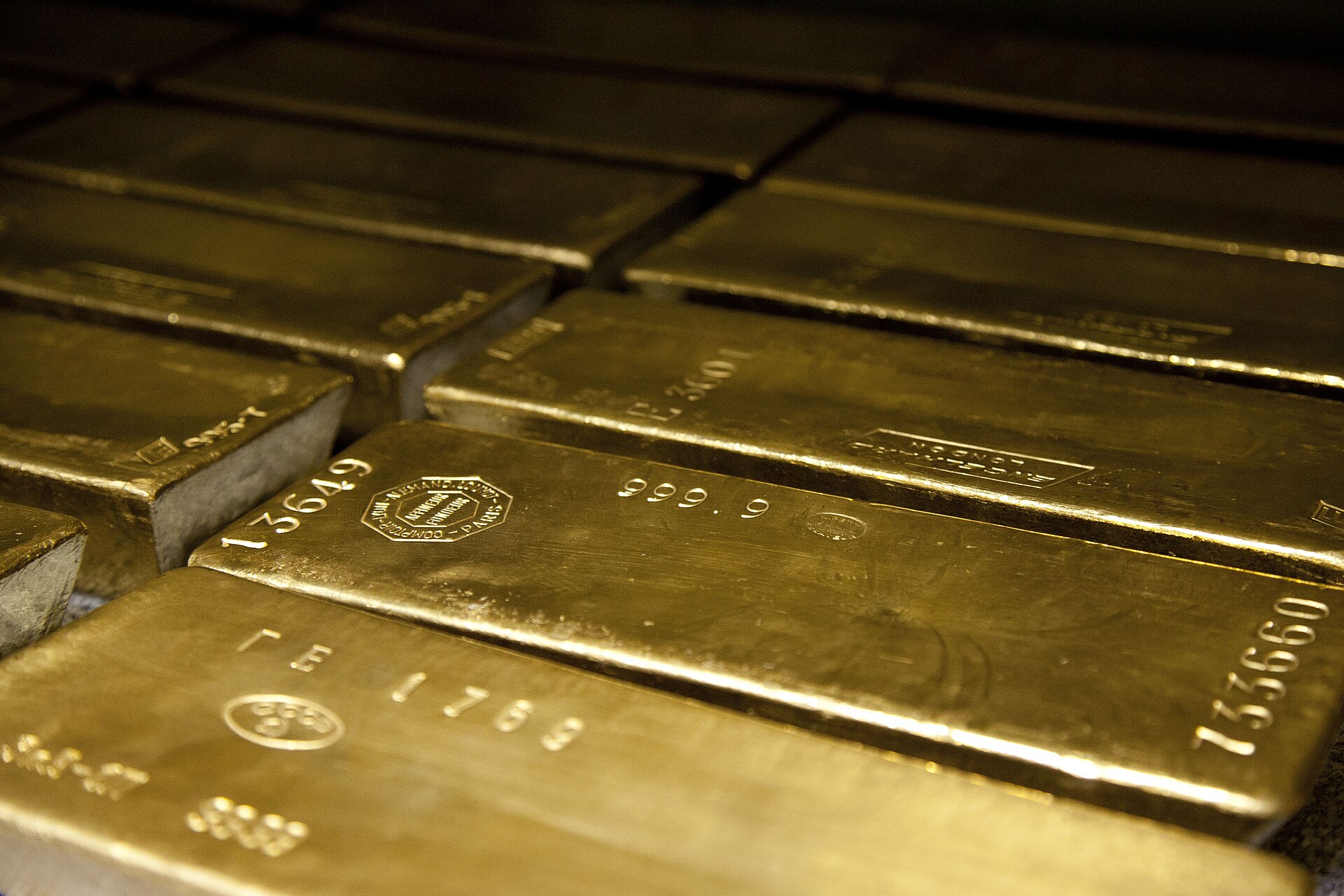
Gold has unusual characteristics as a reserve asset. It is no one’s liability: unlike a government bond, it does not depend on the issuer’s willingness or ability to pay. It can be held domestically, beyond the reach of foreign courts or sanctions authorities. It has a long history as a store of value during inflation and currency crises. Against these advantages, it pays no interest, it can be costly to store and insure, and its price is volatile. A central bank that buys gold is therefore accepting lower expected income and higher price volatility in exchange for specific forms of protection.
Surveys conducted by the World Gold Council among reserve managers have repeatedly cited performance during crises, diversification and the absence of default risk as leading reasons for holding gold. Geopolitical risk and concerns about sanctions also appear prominently. The freezing of a large part of the Bank of Russia’s foreign reserves after the invasion of Ukraine in 2022 is widely discussed as a turning point because it demonstrated that reserves held in foreign financial systems could become unavailable to their owner. It is reasonable to treat that event as a factor in some purchases, but the survey evidence does not allow a precise measure of how much buying it explains.
Other motives are more ordinary. Some central banks hold small gold shares relative to their total reserves and are moving towards a target they consider prudent. Some buy domestic mine production in local currency, which builds reserves without spending foreign exchange. Some respond to inflation or to negative real returns on bonds. Lumping all purchases under a single geopolitical narrative risks overstating a coherent strategy where there may be many separate decisions.
Is this “de-dollarisation”?
The phrase de-dollarisation is often used as though the dollar were about to lose its central role. The evidence supports a narrower conclusion. Reserve managers are diversifying at the margin, and gold is one of the main beneficiaries. That is different from abandoning the dollar. The dollar remains dominant in foreign exchange trading, trade invoicing, cross-border borrowing and the global funding of banks. Bank for International Settlements surveys of foreign exchange turnover show the dollar on one side of close to nine in ten trades. Those network effects are not easily replaced.
A reserve currency needs deep and liquid markets, convertible capital accounts, credible institutions and legal protection for foreign holders. The euro has deep markets but a more fragmented supply of safe government debt. The renminbi is constrained by capital controls. No candidate currently combines every attribute at the scale of the US Treasury market. Gold avoids the issuer question entirely, which is precisely why it gains when concerns focus on political exposure rather than on the quality of a particular currency. Its market, however, is far smaller than that for Treasuries, and it cannot be used directly to settle most international transactions.
A better description is therefore hedging rather than replacement. Some countries want to limit their dependence on a system in which a foreign government can restrict access to their assets. They can reduce that exposure partially through gold, local-currency trade arrangements and diversification across currencies without leaving the dollar system. Whether this marginal hedging gradually becomes a structural shift depends on policy choices in the United States and elsewhere that cannot be forecast from purchase data alone.
How the trend reaches markets
The most direct channel is the gold price. Official sector demand adds to purchases by investors, jewellers and industry. Because central banks are often less sensitive to price than private buyers, their steady accumulation can support demand when higher prices might otherwise discourage purchases. Analysts have noted that gold rose strongly in 2024 and 2025 even as real US interest rates, traditionally a key influence on gold, remained relatively high. Official buying is one plausible explanation for that weaker relationship, alongside investment flows and geopolitical uncertainty; the available data do not isolate one cause.
A second channel concerns government bond markets. If reserve managers allocate a smaller share of new reserves to US Treasuries, demand from that group grows more slowly. The effect on yields depends on who replaces them. Domestic investors, banks, pension funds and foreign private buyers have absorbed much of the issuance in recent years. A gradual change in official demand is therefore more likely to influence the margin than to cause a sudden repricing. Concerns about fiscal deficits and inflation tend to be more immediate drivers of yields, and attributing a yield move to reserve diversification requires specific evidence.
A third channel affects currencies. A slow decline in the dollar’s reserve share does not determine its exchange rate over months or quarters, which depends mainly on interest-rate differentials, growth and risk appetite. Over a much longer horizon, a reduced reserve role could weaken a structural source of demand for dollar assets. Mining equities form a fourth, more indirect channel: a higher gold price can raise producers’ revenues, but costs, operational risks and hedging contracts mean their shares do not mirror the metal one for one.
Risks and limits of the gold strategy
Gold is not risk-free from a reserve manager’s perspective. Its price can fall sharply, as it did between 2011 and 2015, and a central bank with a large allocation would see the value of its reserves decline at the moment it might need them. Selling large quantities during stress could itself depress the price. Gold held abroad, for example in London or New York, provides less protection against political seizure than gold held at home, while domestic storage brings security and verification costs. The insurance has a premium.
There is also a feedback risk. If part of the recent rise in the gold price was driven by official buying, then a slowdown in that buying could remove support. Central banks rarely publish their intentions in advance, and monthly reported data are revised. Market participants who extrapolate past accumulation into the future may be surprised by a pause. Conversely, a further deterioration in geopolitical relations could accelerate purchases. Both directions should be considered.
What to watch, and what would change the analysis
Several observable indicators help distinguish a durable trend from a temporary episode. The first is the official data: monthly IMF International Financial Statistics, quarterly COFER releases and World Gold Council demand estimates. Persistent purchases by a wide range of central banks would indicate a broad shift; concentration in a few buyers would point to country-specific motives. The second is the relationship between gold and real interest rates. If the traditional relationship reasserts itself, the influence of official demand may be weakening. The third is policy: sanctions decisions, the treatment of frozen assets and arrangements for settling trade outside the dollar.
What would invalidate the view presented here? A sharp acceleration in the decline of the dollar’s share of currency reserves, combined with a credible alternative safe asset of comparable scale, would point towards a deeper structural change than hedging. Conversely, a sustained halt in official gold purchases, alongside rising reserve allocations to Treasuries, would suggest that the post-2022 episode was a temporary adjustment. Neither outcome is visible in the dated data used here, which is why both remain scenarios rather than forecasts.
The central conclusion is modest but useful. Central bank gold buying is a signal about how reserve managers rank risks, especially the risk of losing access to assets held abroad. It has supported the gold price and changed the measured composition of reserves. It does not, on its own, show that the dollar’s international role is ending. For markets, the most reliable reading separates the price effect from the volume effect, dates every figure and treats geopolitical explanations as plausible hypotheses that must be tested against the next data releases. This is analysis, not investment advice.
Sources & scope
An explanatory analysis using the dated publications below. Historical figures are not live readings; scenarios are conditional, and market co-movement does not establish causation. Not investment advice.
- IMF Data Brief, COFER fourth quarter 2024 (April 2025)
Dollar share of allocated reserves 57.8% and euro 19.8% in 2024Q4, renminbi 2.18%, long-term decline from roughly 71% around 2000; currencies only, gold excluded.
- World Gold Council, Gold Demand Trends: Full Year 2024
Central bank purchases above 1,000 tonnes for a third consecutive year; includes estimates of unreported buying.
- World Gold Council, Central Bank Gold Reserves Survey
Reserve managers’ stated motives: crisis performance, diversification, absence of default risk, geopolitical concerns.
- European Central Bank, The international role of the euro (June 2025)
Gold overtook the euro in 2024 as the second-largest reserve asset at market value; mix of price and volume effects.
- Bank for International Settlements, Triennial Central Bank Survey (2022)
Dollar on one side of about 88% of foreign exchange trades in April 2022. Market transmission scenarios above are conditional analysis, not reported price movements.